

Does CoolSculpting work? Yes — and the mechanism is specific enough to be worth understanding before you book. Does CoolSculpting work? CoolSculpting permanently eliminates fat cells in targeted areas using controlled cooling. A single session reduces fat in the treated zone by 20–25% on average. Results become visible at four to six weeks and reach their full outcome at three months. The procedure is FDA-cleared, non-surgical, and requires no recovery time.
What CoolSculpting is not: a weight loss treatment. This distinction matters more than most clinics will tell you.
So, does CoolSculpting work for everyone? Understanding the nuances can help set the right expectations.
When considering the question ‘does CoolSculpting work’, it’s essential to look at various factors like individual body types and treatment goals.
Many patients ask, ‘does CoolSculpting work?’ and it’s important to provide comprehensive answers based on clinical evidence.
Knowing how does CoolSculpting work can help reassure potential candidates about its effectiveness.
The growing popularity of CoolSculpting raises the question: does CoolSculpting work for everyone?
Ultimately, the effectiveness remains in the question: does CoolSculpting work when performed correctly on suitable candidates?
What is CoolSculpting?
This leads us to explore: does CoolSculpting work for different body types and fat distributions?
If you find yourself wondering, does CoolSculpting work for your specific concerns, a consultation can provide clarity.
After treatment, patients often ask, does CoolSculpting work in achieving their body goals?
For those curious, does CoolSculpting work, I’ve seen many positive testimonials from satisfied patients.
Does CoolSculpting work for those looking for a non-invasive option? The answer is yes, but it varies.
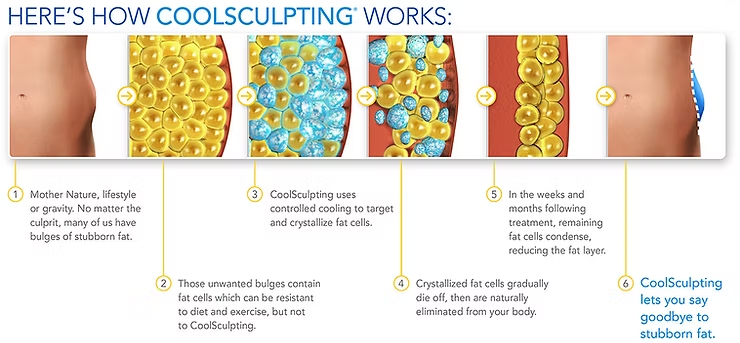
CoolSculpting is the brand name for cryolipolysis — a fat-reduction procedure cleared by the FDA in 2010. The science behind it was discovered at Harvard, where researchers noticed that cold temperatures affect fat cells differently than surrounding tissue. Fat cells are more vulnerable to cold. They crystallize and die at temperatures that leave skin, nerves, and muscle completely unaffected.
When it comes to body contouring, does CoolSculpting work better than traditional methods? That’s a common topic of discussion.
As expected, patients often wonder, does CoolSculpting work for their particular issue?
In clinical settings, the question remains: does CoolSculpting work effectively in real-world applications?
During consultations, we frequently hear the question: does CoolSculpting work for long-term results?
While discussing options, we clarify: does CoolSculpting work better for body contouring compared to other treatments?
That observation became a clinical device. The procedure works on 13 FDA-cleared body areas: abdomen, flanks, inner and outer thighs, upper arms, under the chin, bra-line fat, and others. If the fat is subcutaneous — meaning it sits just beneath the skin and is pinchable — CoolSculpting can reach it.
Many patients ask after their session: does CoolSculpting work as expected based on initial discussions?
In the end, the main question is: does CoolSculpting work effectively for your unique body type and fat distribution?
Clarifying the benefits, we often get asked: does CoolSculpting work in providing a noticeable change?
Patients expressing concerns often ask: does CoolSculpting work as a reliable solution to stubborn fat?
In discussions about treatment, we clarify: does CoolSculpting work without extensive downtime or recovery?
Over 17 million CoolSculpting treatments have been performed worldwide. The evidence base is substantial. This is not a trend; it has been in clinical use for 15 years. The FDA’s clearance history for cryolipolysis devices is publicly available if you want to read the regulatory record.
After sessions, patients often reflect on their experience and ask: does CoolSculpting work for their expected transformations?
When patients express curiosity about outcomes, they frequently ask: does CoolSculpting work as promised?
To that end, we often revisit: does CoolSculpting work in achieving the desired fat loss?
How does CoolSculpting work?
After careful consideration, many conclude that yes, does CoolSculpting work for their needs, and the results speak for themselves.
In conclusion, the question remains: does CoolSculpting work effectively for targeted fat removal?
Ultimately, if you’re considering your options, you might ask: does CoolSculpting work for your specific fat reduction goals?
In the end, we return to the essential question: does CoolSculpting work for you?
To answer your question: does CoolSculpting work? Yes, it is effective for the right candidates seeking localized fat reduction.
So, does CoolSculpting work in terms of fat cell reduction? The answer is a resounding yes for qualified patients.
In summary, if you’re asking yourself does CoolSculpting work, rest assured it has proven results.
Conclusively, when it comes to effectiveness, does CoolSculpting work? It certainly has a place in cosmetic fat reduction.

Patients often wonder: does CoolSculpting work better than diet and exercise alone? Let’s find out.
For those curious about results, the query remains: does CoolSculpting work in a clinical setting?
When evaluating options, many conclude: does CoolSculpting work as intended for reducing stubborn fat?
Overall, the journey leads to the final question: does CoolSculpting work for you, individually?
As always, the fundamental inquiry remains: does CoolSculpting work, and how does it fit within your personal goals?
Wrapping up, if you’re contemplating treatment, you might ask yourself: does CoolSculpting work for your aesthetic needs?
In conclusion, many will wonder: does CoolSculpting work effectively based on the evidence available?
Finally, to the question, does CoolSculpting work? Yes, for those seeking targeted fat loss, it is an effective option.
The CoolSculpting applicator draws the targeted tissue between two cooling panels and holds a precise temperature for 35 to 75 minutes depending on the area. The fat cells underneath the skin crystallize during that window. Once crystallized, they undergo apoptosis — programmed cell death.
The cells do not rupture. They do not release anything into the body. They simply die, and the lymphatic system processes and removes them over the following weeks and months. The elimination is gradual, which is why full results take three months rather than three days.
One clinical detail worth knowing: after the applicator is removed, the treated area is manually massaged for about two minutes. Research shows this step improves final fat reduction by roughly 68%. It is not optional, and it is not pleasant — the tissue is numb and firm immediately post-treatment. It matters.
The session itself is manageable. There is an intense cold sensation in the first few minutes, then numbness. Most patients work on a laptop, read, or rest through the duration. There is no anesthesia. There are no needles.
Who is a good candidate for CoolSculpting?

The standard guideline is a BMI under 30, with discrete areas of stubborn fat that don’t respond to exercise and nutrition. The classic zones: lower abdomen, love handles, inner thighs, under the chin, upper arms. Places where the body stores fat preferentially regardless of how consistently you train.
The “pinch more than an inch” heuristic is a useful starting point. If the target area is firm, hard, and non-pinchable, CoolSculpting cannot reach it — that is visceral fat, which sits inside the abdominal cavity and is outside the scope of this treatment.
There are absolute contraindications. CoolSculpting is not appropriate for people with cryoglobulinemia, cold agglutinin disease, or paroxysmal cold hemoglobinuria — conditions where cold exposure triggers abnormal systemic responses. Cold urticaria (hives from cold) is also a contraindication. If you have unusual reactions to cold, disclose this before your consultation.
A good candidate is someone who is largely where they want to be — and has one or two areas that won’t budge no matter what they do. That is who this treatment was designed for. For under-chin fat specifically, Kybella is an injectable alternative worth discussing at the same consultation if CoolSculpting isn’t the right fit for that area.
CoolSculpting is body contouring, not weight loss

This is the thing most clinics will not say clearly enough, so I’ll say it directly: the scale will probably not change after CoolSculpting.
The number of fat cells in the treated area will. CoolSculpting removes 20–25% of the fat cells in a targeted zone. For a patient near their goal weight with stubborn fat in a specific area, that produces a real, visible change — contour improves, measurements change, clothes fit differently.
For a patient significantly above their goal weight expecting CoolSculpting to move them meaningfully toward it: this is not the right tool. The mechanism does not work that way. The fat reduction is real, but it is localized and moderate. It is a finishing treatment, not a foundational one.
Patients who are frustrated that honest clinics won’t promise dramatic results from CoolSculpting are, in my experience, the patients who were not given an accurate picture of what it does. The patients who get the right expectation get the result they were hoping for.
What to expect during and after treatment

The session: The target area is assessed and photographed, the applicator is positioned and secured, and the cooling begins. Sessions run 35 to 75 minutes per treatment area. Larger plans covering multiple zones can take a full morning. There is no prep beforehand and no recovery required afterward — patients drive themselves home.
When the applicator comes off, the treated tissue is massaged immediately. The area looks red and may feel tender and firm for a few hours. That resolves.
The timeline:
- 2–4 weeks post-treatment: Some patients begin to notice early changes as the body starts processing dead fat cells.
- 4–6 weeks: Visible reduction typically becomes apparent.
- 3 months: Full results. Fat elimination is complete.
The result: A 20–25% reduction in the fat layer of the treated area. For patients with multiple target zones, additional sessions addressing each zone produce additional reductions. Most patients treating a single area require one session. Larger or more resistant areas may benefit from a second.
The results are permanent in the sense that eliminated fat cells are gone. They do not regenerate. What can change afterward: the remaining fat cells in the body can still expand with significant weight gain. Maintaining a stable weight after treatment preserves what CoolSculpting did.
For full details on what a CoolSculpting session at our clinic looks like, see our CoolSculpting service page.
Side effects — including the rare complication worth knowing about
Common side effects are temporary and manageable:
- Redness, swelling, and tenderness at the treatment site — typically resolves within days
- Temporary numbness or tingling — can persist for several weeks in some patients
- Bruising — occurs in roughly 2–10% of cases
- Firmness or aching in the treated area — similar to post-exercise soreness; resolves on its own
Most patients experience minimal disruption to their routine. There is no wound, no suture, no compression garment.
The rare complication worth knowing about is paradoxical adipose hyperplasia (PAH) — a condition where the treated fat responds to the cold by growing denser and firmer rather than reducing. The tissue hardens instead of dying. PAH occurs in roughly 1–2% of CoolSculpting treatments. It is more commonly reported in male patients and in the abdominal area.
It is not dangerous. It does not resolve on its own. Surgical correction is typically required.
This is not a reason to avoid CoolSculpting. It is a reason to be informed before you have it — and to have it performed by a provider who knows what PAH looks like, has seen it, and has a clear management protocol if it occurs. A 2014 case series in Plastic and Reconstructive Surgery first formally described PAH following cryolipolysis; awareness has improved since, but not universally. Providers who have not heard of paradoxical adipose hyperplasia are providers who have not done the clinical reading. Ask about it before you book.
When CoolSculpting is not the right choice
We tell patients not to proceed with CoolSculpting in these situations:
Significant weight loss goal. If you have 30 or more pounds to reach your target weight, this is not the starting point. The remaining fat cells will continue to change with weight fluctuation, and results in a body actively transitioning are unpredictable. Address the weight first.
Active skin conditions at the treatment site. Eczema, psoriasis, rash, or open wounds at the intended treatment area are contraindications. The skin needs to be intact and healthy.
Expecting dramatic full-body change. CoolSculpting reduces fat in specific zones. It does not replace the foundational work of nutrition and exercise. Patients who approach it as a refinement tool — not a transformation — are the ones who walk away satisfied.
Pregnancy or breastfeeding.
Cold-related conditions. Cryoglobulinemia, paroxysmal cold hemoglobinuria, and cold agglutinin disease are absolute contraindications.
The consultation is where all of this gets sorted. If you’re unsure whether you’re a good candidate, that uncertainty is the right reason to book one. We’ve been doing this in Redding since 1999. We will tell you directly either way.
If your goal is fat reduction combined with muscle definition, CoolTone addresses the muscle layer through focused magnetic stimulation and pairs well with CoolSculpting for patients with a dual goal. Both treatments are offered here; the right combination depends on what you’re working toward.
Frequently asked questions
Does CoolSculpting actually work?
Yes. CoolSculpting produces measurable, permanent fat reduction — 20–25% per session in the treated area, with full results visible at three months. The eliminated fat cells are gone. The limitation: it is a body contouring treatment, not a weight loss method. Patients near their goal weight with specific, stubborn areas get clear results. Patients significantly above goal weight will not get the outcome they’re imagining.
How long do CoolSculpting results last?
The fat cells eliminated by CoolSculpting are permanently gone — they do not regenerate. What can change after treatment is the remaining fat cells elsewhere in the body. Significant weight gain after treatment can expand remaining fat cells, including in the treated area. Maintaining a stable body weight preserves the result long-term.
What is the downside of CoolSculpting?
The main limitations are that it is not effective for significant weight loss, results take up to three months to fully appear, and paradoxical adipose hyperplasia — where the treated fat hardens rather than reduces — affects roughly 1–2% of treatments. Common side effects (numbness, temporary soreness, occasional bruising) are temporary and manageable.
Does CoolSculpting work on belly fat?
Yes. The abdomen is one of the most commonly treated areas. CoolSculpting addresses subcutaneous abdominal fat — the fat you can pinch. It does not address visceral fat inside the abdominal cavity. If your belly protrudes but is firm, hard, and non-pinchable, CoolSculpting is unlikely to produce significant change. A consultation determines which type predominates.
How many CoolSculpting sessions do I need?
Most single target areas require one to two sessions. Larger areas, higher fat volume, or multiple target zones mean more sessions. Your provider should give you a realistic session count at consultation — sized to your actual anatomy, not to fill a calendar. At our clinic, consultations are applied toward your first treatment.
Is CoolSculpting better than liposuction?
They are different tools. CoolSculpting is non-surgical, requires no recovery time, and reduces fat by 20–25% per session. Liposuction is surgical, removes more fat in a single intervention, and carries anesthesia, recovery time, and surgical risk. For moderate fat in specific zones, CoolSculpting is a reasonable non-surgical option with no downtime. For larger-volume fat removal or more significant reshaping, liposuction is more effective. The American Society of Plastic Surgeons has a detailed comparison of both approaches if you want to read further before a consultation.
